

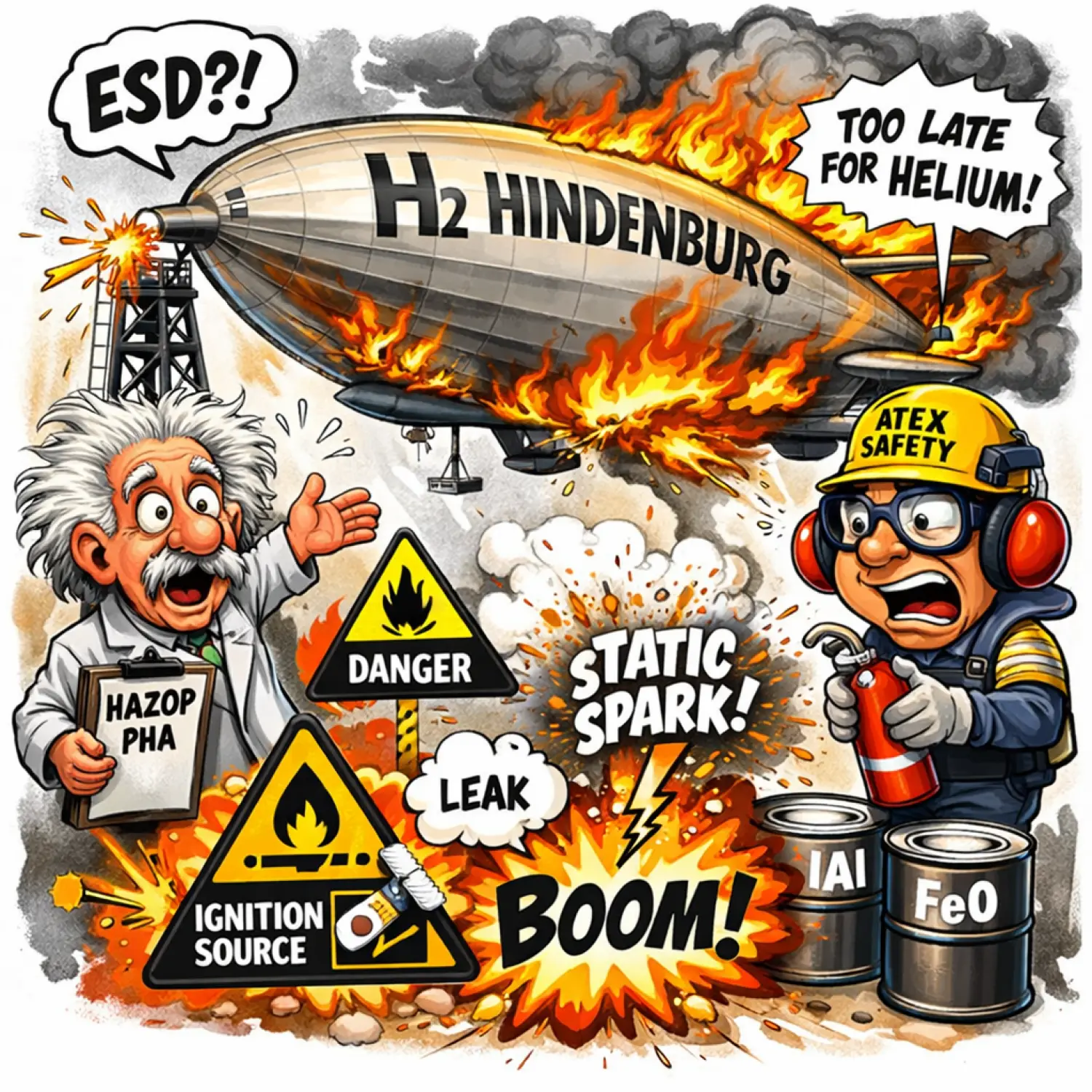
The Hindenburg disaster (May 6, 1937, Lakehurst, USA) was not a classical explosion, but primarily a rapidly spreading fire that engulfed the airship within seconds.
What Actually Happened?
The German airship LZ 129 Hindenburg was filled with hydrogen, a highly flammable gas. During the landing maneuver:
Within seconds, flames spread across the entire airship structure.
Explosion or Fire?
Technically speaking: 1) It was not a detonation 2)It was a very rapid hydrogen combustion (deflagration), because the burning process was extremely fast and involved a very large structure, witnesses perceived it as an explosion. In reality, it was a rapidly spreading fire that destroyed the airship in about 30–40 seconds.
Why Did It Look Like an Explosion?
Several factors contributed to the dramatic appearance:
Therefore the event appeared explosion-like, even though no classical blast wave was produced.
A Remarkable Technical Detail (From an Explosion Protection Perspective): modern research suggests that the initial ignition may not have started with hydrogen, but rather with the outer coating of the airship.
The coating contained:
This combination made the surface highly flammable. A static discharge could have ignited the coating first, after which the hydrogen rapidly caught fire.
Why the Hindenburg Disaster Is Important for Explosion Protection?
The Hindenburg accident demonstrates several fundamental principles that today form the basis of ATEX Directive 2014/34/EU and IECEx System safety philosophy.
1️⃣ Flammable Atmosphere + Ignition Source = Disaster
Hydrogen has two critical properties (besides others):
A likely sequence of events:
This perfectly illustrates the explosion triangle: presence of fuel, oxidizeR and ignition source.
2️⃣ Static Electricity – An Underestimated Ignition Source
During landing, the airship likely accumulated electrostatic charge. When the mooring lines touched the ground:
For this reason, modern hazardous-area installations require:
3️⃣ Material Selection Risks
The airship's outer coating contained aluminum powder and iron oxide, which made it highly flammable and capable of sustaining intense combustion. This illustrates a key engineering lesson: A system can become dangerous due to non-obvious material properties.
Today this is addressed through:
4️⃣ Energy Carrier Selection Matters
The choice of hydrogen was largely a political and economic compromise. A safer lifting gas, Helium, was available but could not be obtained because the United States restricted its export at the time.
5️⃣ Lack of Structured Hazard Analysis
Today, a system like this would require extensive safety studies, such as:
In 1937, such systematic safety methodologies did not yet exist.
6️⃣ Deflagration vs. Detonation
The event was a deflagration, not a detonation.
|
Phenomenon |
Characteristics |
|
Deflagration |
Flame front slower than the speed of sound |
|
Detonation |
Supersonic combustion with a shock wave |
The Hindenburg burned for about 30 seconds, which is consistent with rapid gas combustion, not detonation.
Key Explosion Protection Lessons
The Hindenburg disaster clearly demonstrates that:
An Ex protection paradox today:
If the Hindenburg were designed according to modern ATEX principles, the classification would likely be:
Keep up the good work!
Arpad
veress@exprofessional.com
Note: Your comment will only appear on the site after review. Your email address will not be visible, only your name and comment.