

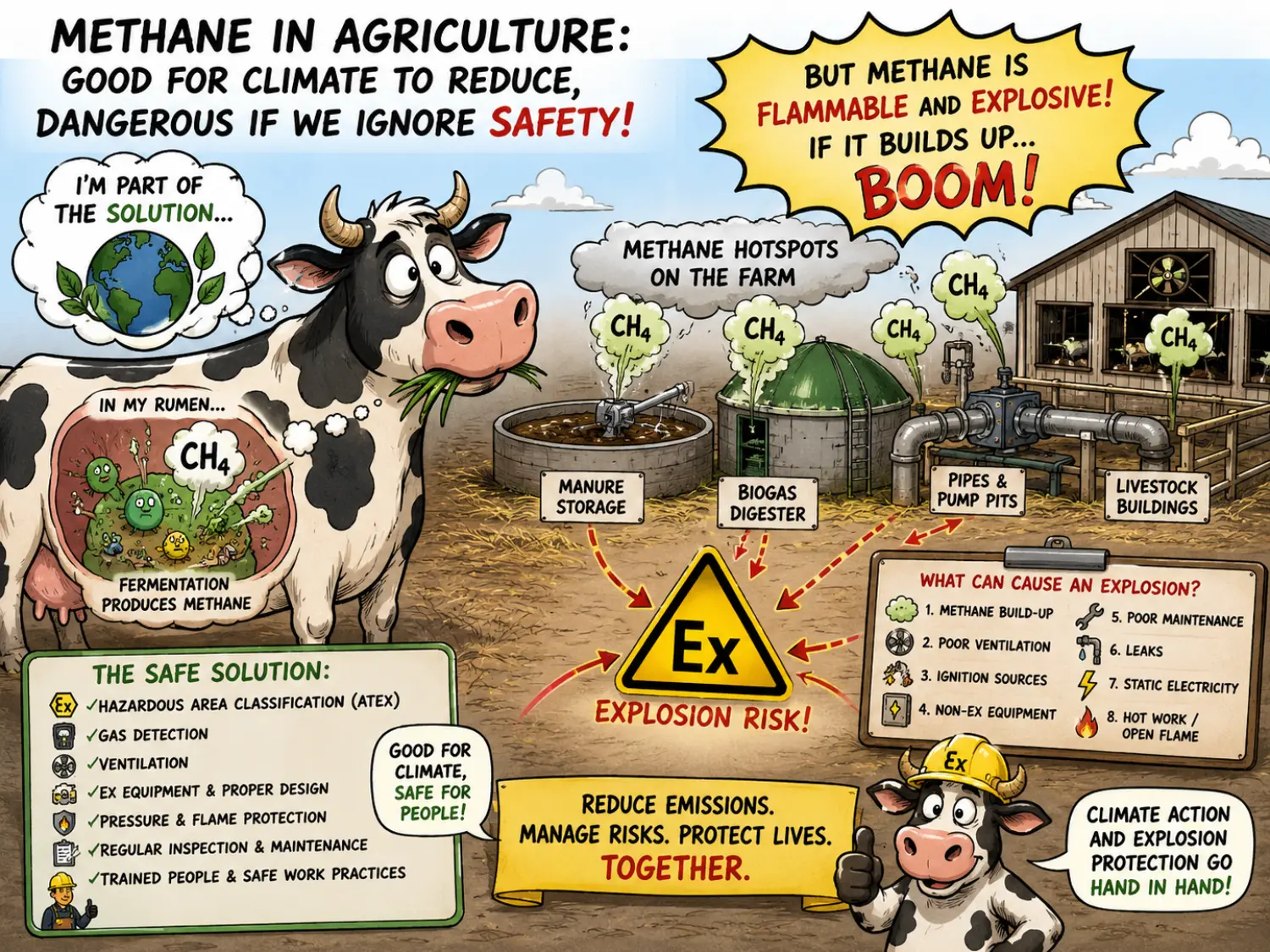
The issue of agricultural methane emissions has increasingly come to the forefront in recent years, primarily from a climate protection and emission reduction perspective. However, the subject is in reality far more complex than that. Methane is not only a significant greenhouse gas, but also a flammable and potentially explosive medium. For this reason, environmental, eneragy-related, and explosion protection considerations cannot be separated when assessing agricultural technologies and processes.
The main sources of methane emissions in agriculture are the enteric fermentation processes of ruminant animals and the handling and storage of organic manure generated during livestock farming. Liquid manure systems, anaerobic manure storage facilities, and biogas technologies represent particularly significant risks, as the decomposition of organic matter in these systems continuously generates methane. These technologies have become a major focus of climate policy because the agricultural sector contributes substantially to national methane emissions and therefore plays a key role in achieving emission reduction targets. At the same time, the very same processes that represent an environmental challenge also create potentially explosive atmospheres from an explosion protection perspective.
Methane is a flammable gas with low ignition energy that can form explosive mixtures with air within certain concentration ranges. In enclosed or partially enclosed technological systems — such as fermenters, manure storage tanks, gas membrane storage units, pipelines, pump pits, or poorly ventilated livestock buildings — explosive atmospheres can easily develop. In such systems, the presence of methane is not an occasional phenomenon but rather an inherent characteristic of the technology itself, meaning that continuous or frequently occurring hazardous atmospheres must often be expected.
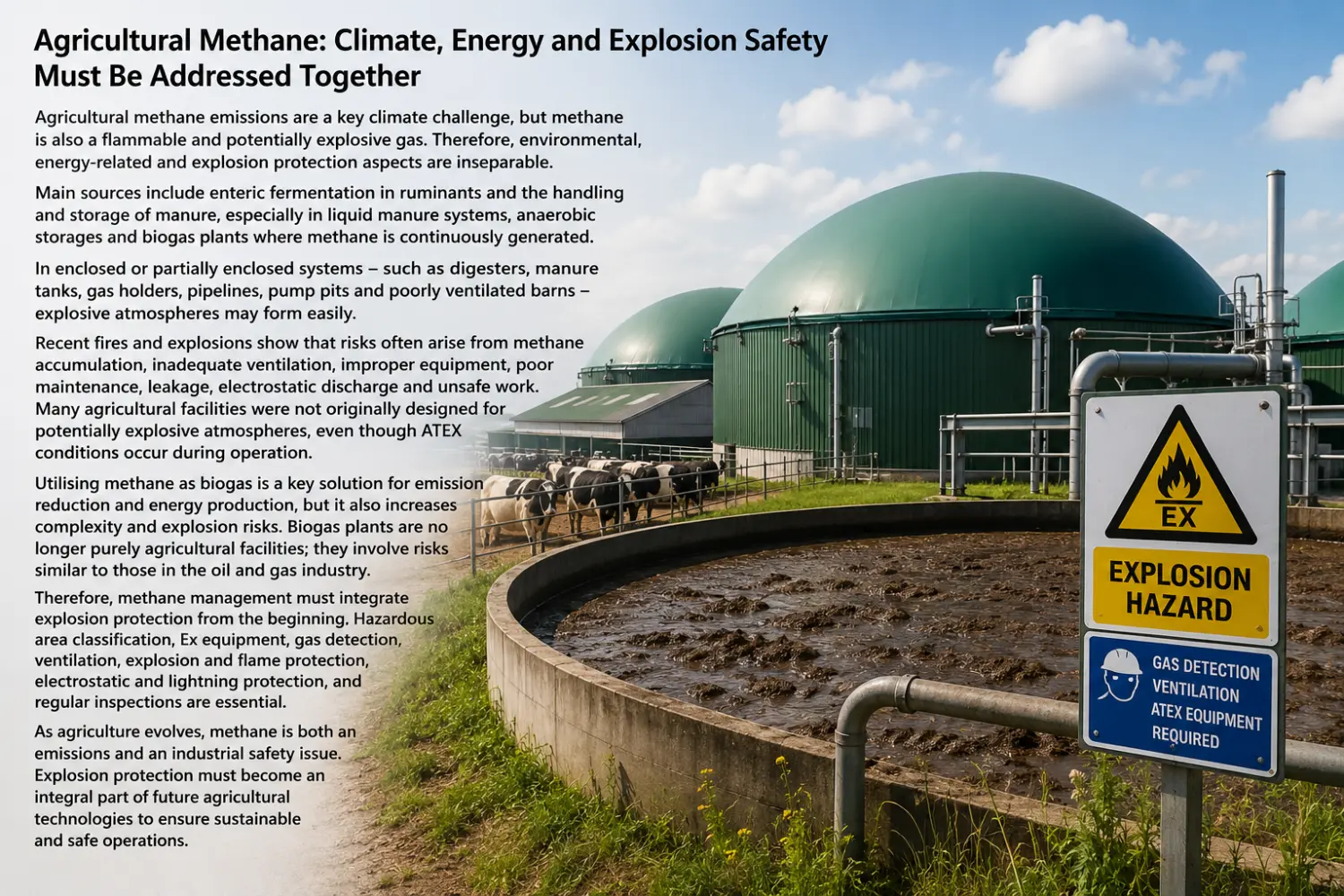
Several fires and explosions in recent years have demonstrated that explosion protection practices in agricultural and biogas-related technologies frequently fail to keep pace with technological development. These incidents are often linked to methane accumulation, insufficient ventilation, improperly selected electrical or mechanical equipment, maintenance deficiencies, inadequate gas tightness, electrostatic discharge, or unsafe work practices. An additional challenge is that many agricultural facilities were not originally designed as potentially explosive environments, even though actual ATEX conditions may develop during operation.
One of the most important directions for reducing methane emissions is the energetic utilization of methane in the form of biogas. This approach can simultaneously support emission reduction, energy efficiency, and circular economy objectives. However, it also significantly increases technological complexity and the potential for explosion hazards. The operation of biogas plants no longer represents purely agricultural activity; rather, these facilities become gas handling and energy generation systems that, in many respects, involve risks similar to those found in conventional oil and gas installations.
For this reason, agricultural methane management cannot be properly addressed solely as a climate protection or energy issue. Emission reduction measures and new technologies can only be considered sustainable and safe if explosion protection is integrated into them from the outset. Hazardous area classification, the application of appropriately certified Ex equipment, gas detection systems, ventilation, explosion and flame propagation protection, electrostatic and lightning protection measures, as well as regular technical inspections, must all become fundamental elements of these systems.
As a result of the ongoing technological and energy transformation within agriculture, methane can no longer be regarded exclusively as an emissions or sustainability issue. It has simultaneously become an industrial safety and explosion protection issue as well. The rapid expansion of biogas and biomass technologies, the growth of decentralized energy production, and the increasing concentration of large-scale livestock farming mean that explosion protection must become an integral part of future agricultural technologies. Climate objectives and technological progress can only be sustainable in the long term if safety engineering and explosion protection requirements are given equal importance in the design, operation, and regulation of these systems.
Keep up the good work!
Note: Your comment will only appear on the site after review. Your email address will not be visible, only your name and comment.