

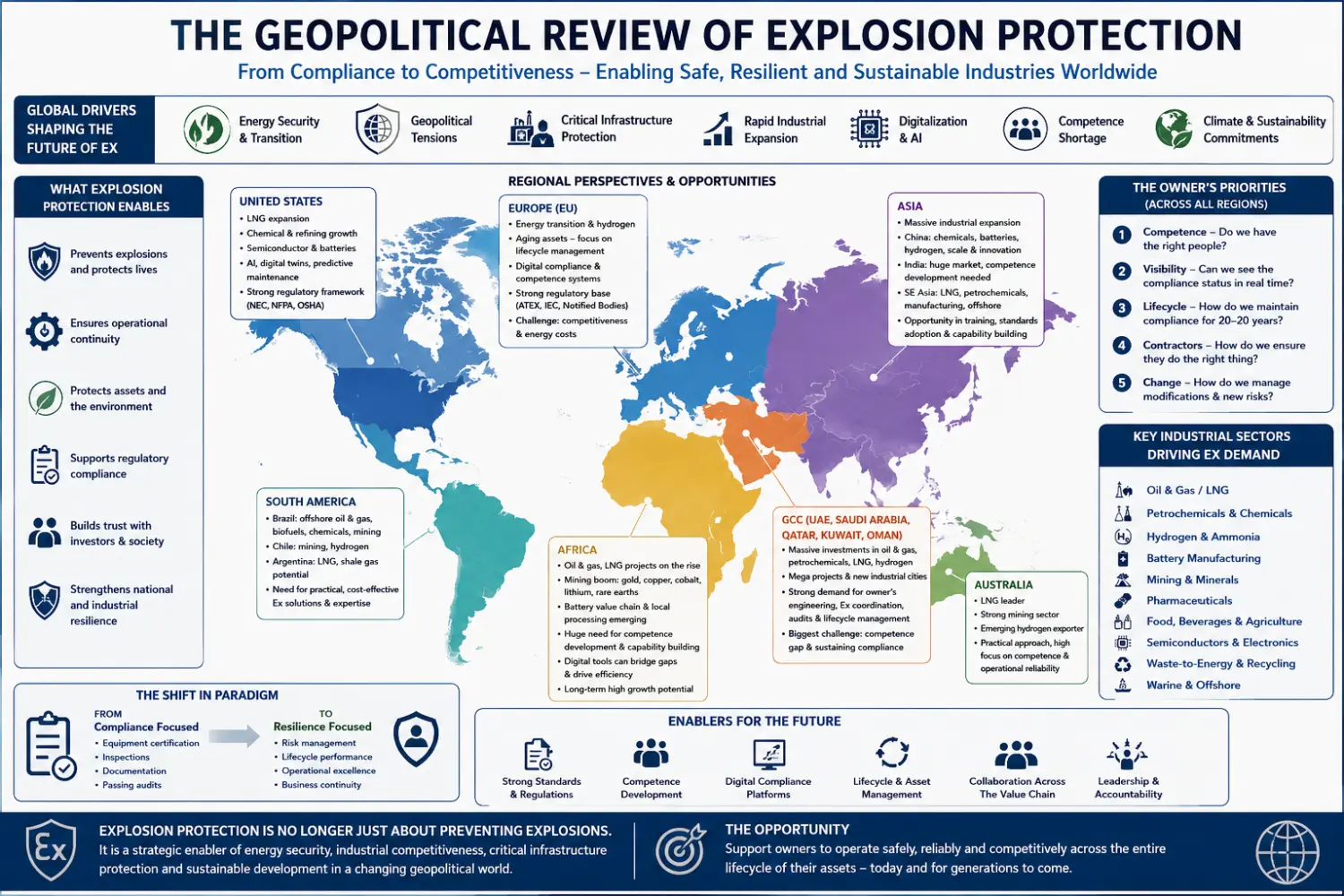
The global industrial landscape is undergoing one of the most significant transformations in modern history. Energy transition, industrial digitalization, critical infrastructure protection, supply chain resilience, and geopolitical competition are reshaping entire industries. As a result, explosion protection is no longer only about preventing ignition sources in hazardous areas. It is increasingly becoming a strategic enabler of industrial resilience and competitiveness.
The industries receiving the largest investments worldwide all have one common characteristic: they depend on the safe management of flammable gases, vapours, combustible dusts, or explosive processes. Hydrogen production, LNG infrastructure, battery manufacturing, renewable fuels, semiconductor fabrication, petrochemicals, pharmaceuticals, mining, food processing, and waste-to-energy facilities all require robust explosion protection strategies.
The question is therefore no longer whether explosion protection is necessary. The question is how effectively it can support the growth and sustainability of these industries.
Europe: Optimizing and Maintaining
Europe remains one of the most mature explosion protection markets in the world. Strong legislation established certification systems, and decades of industrial experience have created a highly developed compliance environment.
However, the challenge facing Europe is different from many other regions. The focus is increasingly shifting from expansion toward optimization. Aging infrastructure, energy costs, and industrial competitiveness are becoming key concerns.
For European asset owners, the opportunity lies in lifecycle management. Digital compliance systems, competence management, management of change, and asset integrity programs may provide greater value than simply increasing inspection activities. The future European Ex market is likely to focus on maintaining safe and competitive operations throughout the lifecycle of existing assets.
United States: Industrial Scale and Innovation
The United States continues to invest heavily in LNG, chemicals, advanced manufacturing, and semiconductor production. Large-scale industrial projects create substantial demand for hazardous area expertise and operational compliance management.
At the same time, the United States is likely to lead the integration of digital technologies into industrial operations. Artificial intelligence, predictive maintenance, digital twins, and data-driven inspection programs could significantly transform the way explosion protection is managed.
The opportunity in the United States lies not only in compliance but in integrating explosion protection into broader operational excellence programs.
GCC: Growth and Ambition
The Gulf Cooperation Council countries represent perhaps the most dynamic opportunity for the explosion protection sector.
Massive investments in oil and gas, petrochemicals, LNG, hydrogen, and industrial megaprojects continue across the region. New facilities are being designed and constructed at an unprecedented pace.
The challenge is no longer limited to engineering design. The larger challenge is building and maintaining competence. Facilities may be constructed within a few years, but developing experienced personnel capable of operating them safely can take decades.
This creates significant opportunities for owner's engineering services, Ex coordination, competency development, auditing, and lifecycle compliance management.
Asia: Scale and Industrial Expansion
Asia represents multiple distinct markets, each with its own characteristics.
China continues to dominate battery manufacturing, chemicals, and industrial production. India is rapidly expanding its industrial base and is likely to become one of the largest future markets for explosion protection expertise. Southeast Asia continues to invest in petrochemicals, LNG, manufacturing, and offshore energy.
Across the region, the greatest opportunity may be competence development. Industrial growth is often outpacing the availability of qualified hazardous area professionals.
The organizations capable of transferring knowledge, building competency frameworks, and supporting local capability development will play an increasingly important role.
South America: Underestimated Potential
South America is frequently overlooked in discussions about explosion protection markets. Nevertheless, the region offers significant opportunities in offshore oil and gas, mining, biofuels, chemicals, and emerging energy projects.
Many operators seek practical and cost-effective support rather than large-scale consulting programs. This creates opportunities for specialized technical advisors capable of delivering measurable value throughout the asset lifecycle.
Australia: Practical Excellence
Australia occupies a unique position. Strong mining, LNG, and future hydrogen sectors create continuous demand for explosion protection expertise.
The Australian market has traditionally focused on practical implementation, operational reliability, and competence rather than documentation alone. This aligns closely with the growing global trend toward lifecycle-based compliance management.
As hydrogen projects expand, Australia may become one of the most influential markets for future explosion protection innovation.
Africa: The Next Frontier for Explosion Protection
Africa is often viewed as an emerging market, yet from an explosion protection perspective it may represent one of the largest long-term growth opportunities globally.
Unlike Europe, where much of the industrial infrastructure already exists, many African countries are still building significant portions of their energy, mining, manufacturing, and logistics capacity. This creates a unique opportunity to implement modern explosion protection concepts from the beginning rather than retrofitting aging facilities decades later.
Historically, the African Ex market has been driven primarily by oil and gas activities in countries such as Nigeria, Angola, Algeria, Libya, Egypt, and Mozambique. However, the future growth story is likely to be much broader.
Mining remains one of the strongest sectors. Gold, copper, cobalt, lithium, platinum, manganese, uranium, and rare earth minerals are attracting increasing global attention due to their importance in the energy transition. Many mining operations involve combustible dusts, explosive atmospheres, fuel storage, processing plants, and hazardous material handling systems, all of which require competent explosion protection management.
Africa is also becoming increasingly important in the global battery value chain. Countries rich in lithium, cobalt, graphite, and other critical minerals are moving beyond raw material extraction and exploring local processing and manufacturing opportunities. This creates new requirements for hazardous area classification, ignition risk assessment, and lifecycle compliance management.
LNG developments are another major driver. Projects in Mozambique, Tanzania, Senegal, Mauritania, and other regions are attracting significant international investment. As these projects mature, demand will increase not only for certified equipment but also for competent personnel, inspection programs, maintenance systems, and operational compliance frameworks.
One of the most significant opportunities across Africa is competence development. In many regions, industrial investment is growing faster than the availability of experienced hazardous area professionals. This creates demand for training, competency assessment, mentoring programs, Ex coordination services, and long-term capability development.
From an owner's perspective, the challenge is often not the availability of equipment but the availability of expertise. Facilities can import certified equipment from anywhere in the world, but developing local competence, inspection capability, maintenance quality, and sustainable compliance systems requires long-term investment.
Digital technologies may also play an important role. Mobile inspection tools, cloud-based compliance platforms, remote audits, digital competence records, and centralized asset management systems can help bridge geographical and resource limitations while improving visibility across large and remote operations.
The greatest opportunity in Africa may therefore not be equipment sales or certification activities. It may be the development of sustainable compliance ecosystems that combine technology, competence, operational excellence, and local capability building.
As global investment continues to flow into energy, mining, critical minerals, and industrial development projects, Africa has the potential to become one of the most important long-term growth markets for explosion protection professionals, service providers, and technology companies.
The Owner's Perspective
Regardless of geography, owners around the world are asking remarkably similar questions. Do we have competent people? Can we see the compliance status of our facilities in real time? How do we manage modifications safely? How do we control contractors? How do we maintain compliance throughout the entire lifecycle of our assets?
These questions cannot be answered by certification alone. They require systems, processes, competence, visibility, and leadership. This is where the future of explosion protection is heading.
Beyond Compliance
The explosion protection profession stands at an interesting crossroads. Historically, the industry focused on equipment, inspections, and documentation. These activities remain essential, but they are no longer sufficient on their own. The next decade will likely see a shift toward integrated lifecycle management, digital compliance systems, competency assurance, and owner-focused support services. The most successful organizations will not be those that simply help facilities pass inspections. They will be those that help owners operate safely, reliably, competitively, and sustainably throughout the entire lifecycle of their assets.
If we were ranking the regions by future Ex growth potential (2030–2040) rather than today's market size:
The reason is simple:
Europe already has Ex infrastructure. All the others are still building it.
And historically, the biggest opportunities in engineering do not come from maintaining existing systems—they come from helping create the next generation of industrial infrastructure.
Keep up the good work!
Note: Your comment will only appear on the site after review. Your email address will not be visible, only your name and comment.