

IEC 60079-0 Edition 8 – Key Changes
Electrostatic protection requirements have been significantly strengthened.
The new requirements cover:
Additional requirements include:
These changes are particularly important for:
Edition 7 allowed certain risks to be managed through Specific Conditions of Use (X marking).
Edition 8 removes this approach for many portable products.
Manufacturers must now demonstrate compliance through:
If the equipment fails these tests, design modifications are required. User instructions alone are no longer sufficient.
For motors and other rotating equipment using forced-air or liquid cooling:
Reliance on operator intervention is no longer acceptable for newly certified equipment.
Clause 19, previously reserved for future use, has been fully introduced.
Factory-installed wiring between certified enclosures is now considered part of the certified equipment and must be:
This is particularly relevant for:
Ingress Protection (IP) requirements have been expanded.
Manufacturers must now demonstrate the required IP rating:
The complete connector system must be evaluated rather than relying solely on supplier IP ratings.
The philosophy behind equipment marking has changed.
Previous practice:
Edition 8:
This reduces reliance on advisory text and improves consistency during installation and inspection.
Edition 8 introduces the possibility of using:
These supplement, but do not replace, mandatory equipment markings.
The scope of the standard has been expanded to include additional battery chemistries, including:
reflecting their increasing use in hazardous-area applications.
For the first time, the standard acknowledges cybersecurity for connected Ex equipment.
Although no mandatory technical requirements are introduced yet, the inclusion signals the future direction of the IEC 60079 series.
Edition 8 places greater emphasis on:
The standard increasingly views Ex equipment as part of an integrated installation rather than as isolated certified products.
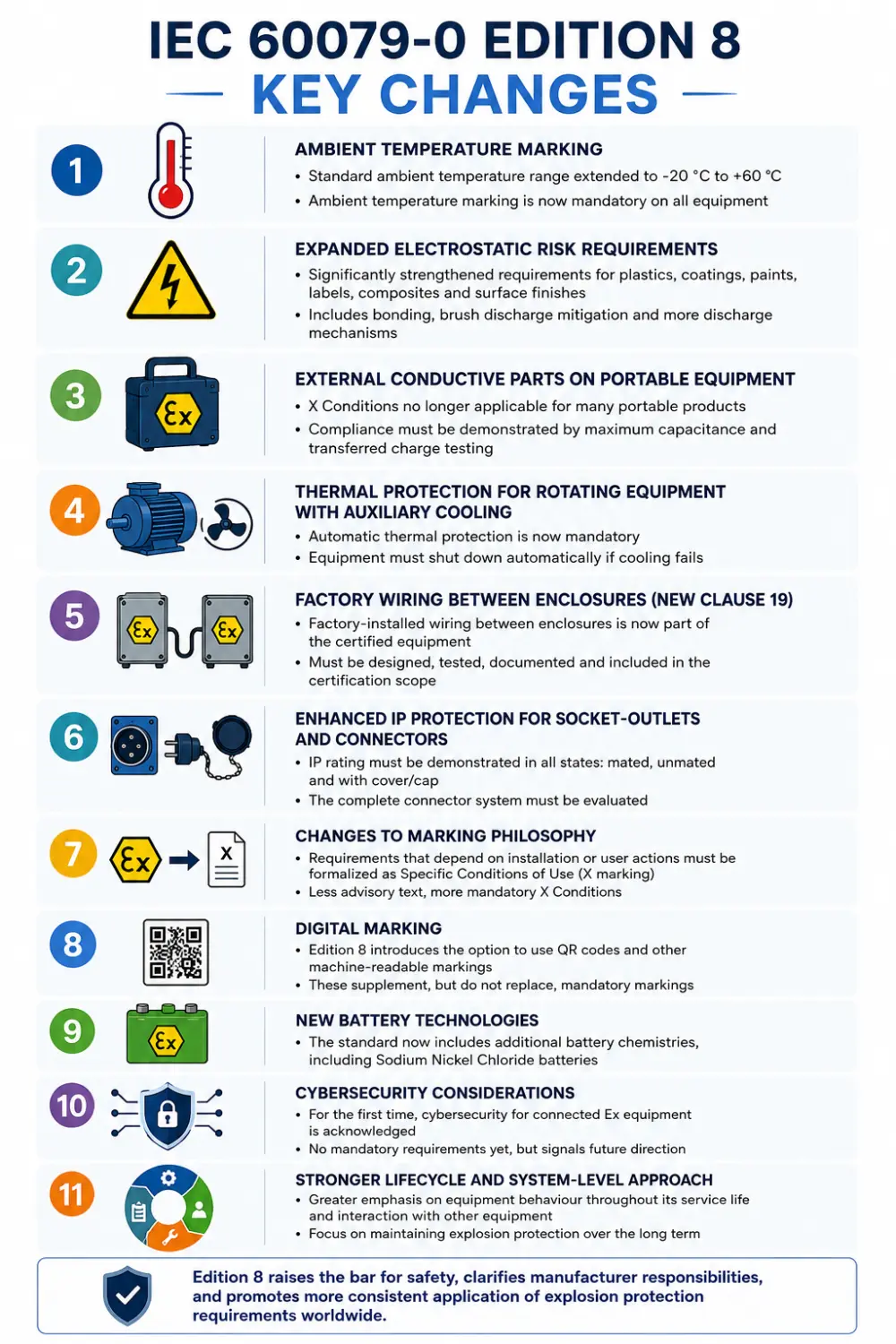
Summary of the Main Changes
|
No. |
Key Change |
|
1 |
Mandatory ambient temperature marking (+60 °C standard range) |
|
2 |
Expanded electrostatic risk requirements |
|
3 |
New testing requirements for conductive parts on portable equipment |
|
4 |
Mandatory automatic thermal protection for auxiliary-cooled rotating equipment |
|
5 |
New requirements for factory wiring between certified enclosures (Clause 19) |
|
6 |
Enhanced IP verification for socket-outlets and connectors |
|
7 |
Revised marking philosophy with increased use of formal Specific Conditions of Use (X marking) |
|
8 |
Introduction of digital marking (QR codes and machine-readable information) |
|
9 |
Inclusion of new battery technologies |
|
10 |
Recognition of cybersecurity considerations |
|
11 |
Stronger lifecycle and system-level safety philosophy |
Keep up the good work!
Note: Your comment will only appear on the site after review. Your email address will not be visible, only your name and comment.