

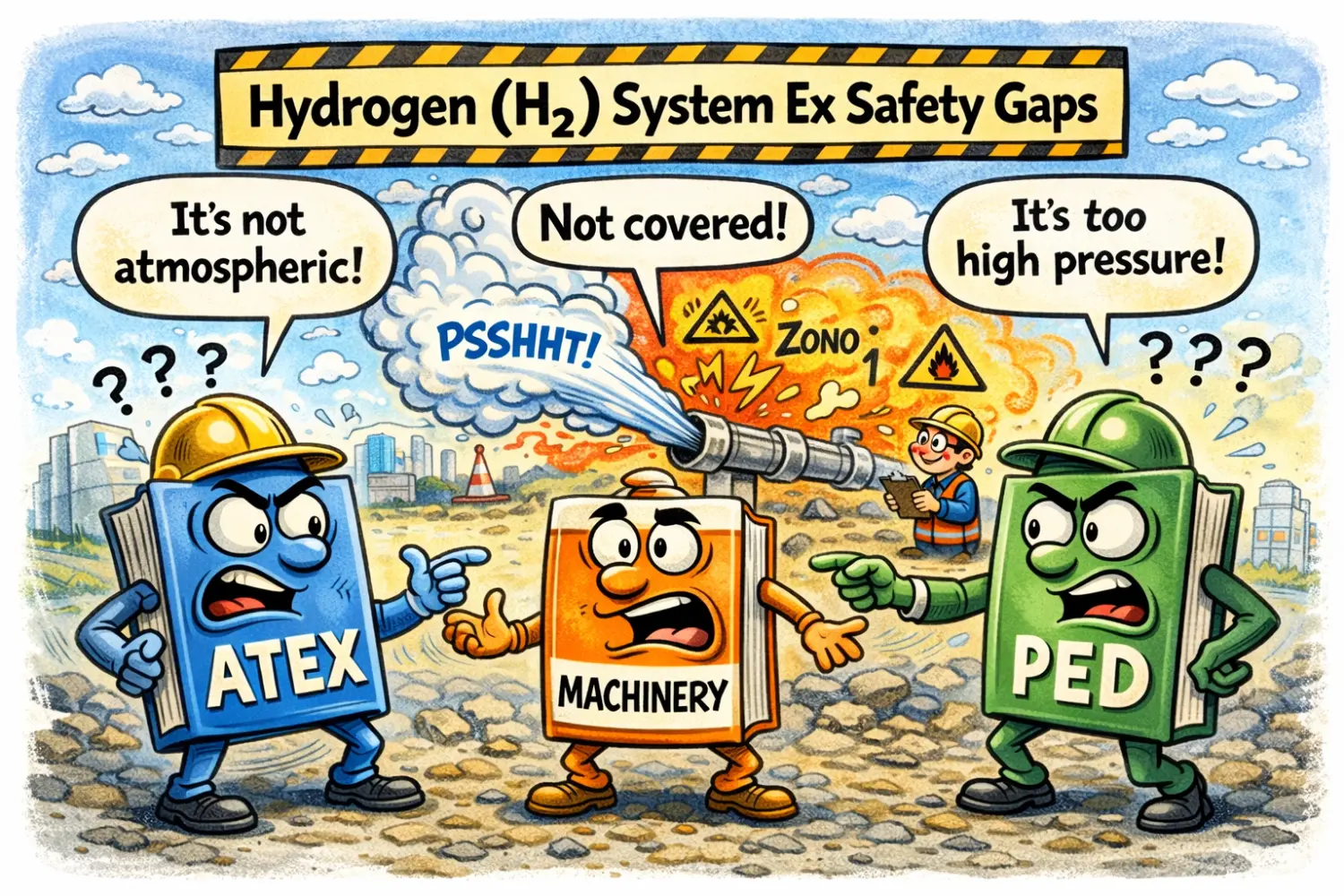
A real regulatory gap that is currently being discussed in hydrogen safety circles (IEC TC31, ISO TC197, EU ATEX working groups). The issue arises because modern hydrogen systems operate far outside the assumptions of classical ATEX, yet leakage inevitably creates an atmospheric explosive mixture.
1) The regulatory conflict (simplified)
Hydrogen systems today - Typical H₂ systems:
|
Parameter |
Conventional ATEX assumption |
Modern H₂ systems |
|
Pressure |
~1–40 bar |
350–900 bar (sometimes higher) |
|
Location |
Atmosphere |
Pressurized closed systems |
|
Hazard formation |
External gas release |
High-pressure leak → rapid jet release |
ATEX was historically written for:
where gas systems operate close to atmospheric pressure.
2) Why ATEX seems "not applicable"
ATEX Directive 2014/34/EU applies only if: equipment is intended for use in potentially explosive atmospheres under atmospheric conditions.
Atmospheric conditions (definition):
High-pressure hydrogen systems:
Therefore inside the system ATEX is not applicable (see Machinery regulation).
3) But the paradox appears at leakage
When a hydrogen system leaks: 1) Gas expands rapidly 2) Pressure drops to atmospheric 3) H₂ mixes with air
Now the conditions become:
ATEX becomes relevant in the surrounding area. This is exactly the interface between two legal "frameworks".
4) Machinery Regulation clarification
EU Machinery Regulation 2023/1230 (Article related to hazardous substances – often referred to via essential requirement 1.5.7)
Key concept: If hazardous substances are inside machinery, the manufacturer must ensure safe containment and operation. Therefore (Inside the machine): ✔ manufacturer responsibility ✔ pressure safety ✔ leak prevention ✔ integrity
5) When ATEX enters again
ATEX applies when possible explosive atmosphere can occur outside the equipment.
Examples:
|
Situation |
Applicable framework |
|
Hydrogen inside vessel (700 bar) |
Machinery + Pressure Equipment |
|
Pipe rupture inside system |
Machinery |
|
Hydrogen leak forming explosive atmosphere |
ATEX Workplace Directive |
|
Equipment installed in classified zone |
ATEX equipment directive |
Workplace obligation: ATEX Workplace Directive 1999/92/EC
Operator must:
6) Role of Notified Bodies (European Union Notified Bodies for ATEX)
Third-party approval is needed when:
In hydrogen systems this appears for example with:
7) The practical approach here
The modern solution used in hydrogen industry is Separation of responsibilities
|
Scope |
Responsible |
Regulation |
|
High-pressure hydrogen system |
Manufacturer |
Machinery + Pressure Equipment |
|
Leakage risk |
Risk assessment |
Functional safety |
|
Area classification |
Operator |
ATEX Workplace |
|
Equipment in classified zone |
Manufacturer + Notified Body |
ATEX Equipment |
8) Engineering strategy used in hydrogen systems
1. Design for "no hazardous area" (Most hydrogen installations try to avoid ATEX zones entirely).
Methods:
Goal: Zone 2 → Non-hazardous. This is widely used in:
2. Secondary explosion protection
If zones cannot be avoided so the use of certified equipment (Ex rated), ignition control and electrical and mechanical classification becomes mandatory.
3. Safety layer concept
Hydrogen systems typically apply multiple protection layers:
|
Layer |
Example |
|
Prevention |
leak-tight system |
|
Detection |
H₂ sensors |
|
Dilution |
ventilation |
|
Shutdown |
emergency stop |
|
Explosion protection |
ATEX equipment |
9) The real regulatory gap (currently debated)
The challenge is that:
Therefore the safety concept is evolving toward integrated functional safety + explosion protection
Relevant standards being developed:
|
Standard |
Purpose |
|
ISO 19880 |
hydrogen fueling |
|
IEC 60079-10-1 |
hazardous area classification |
|
IEC 60079-2 |
pressurized systems |
|
ISO 19880-1 |
hydrogen stations safety |
10) Practical rule used in industry
A simplified rule engineers often apply Inside system → Machinery + Pressure safety
Outside system → ATEX
11) Key design principle
The most robust philosophy for hydrogen systems is to prevent explosive atmosphere formation rather than rely on explosion protection. This aligns with the hierarchy in ATEX Directive 1999/92/EC
12) Practical example
Hydrogen compressor skid (350 bar):
|
Element |
Regulation |
|
Compressor housing |
Machinery |
|
Pressure vessel |
Pressure Equipment Directive |
|
Hydrogen leak scenario |
ATEX risk assessment |
|
Electrical panel near leak source |
ATEX equipment |
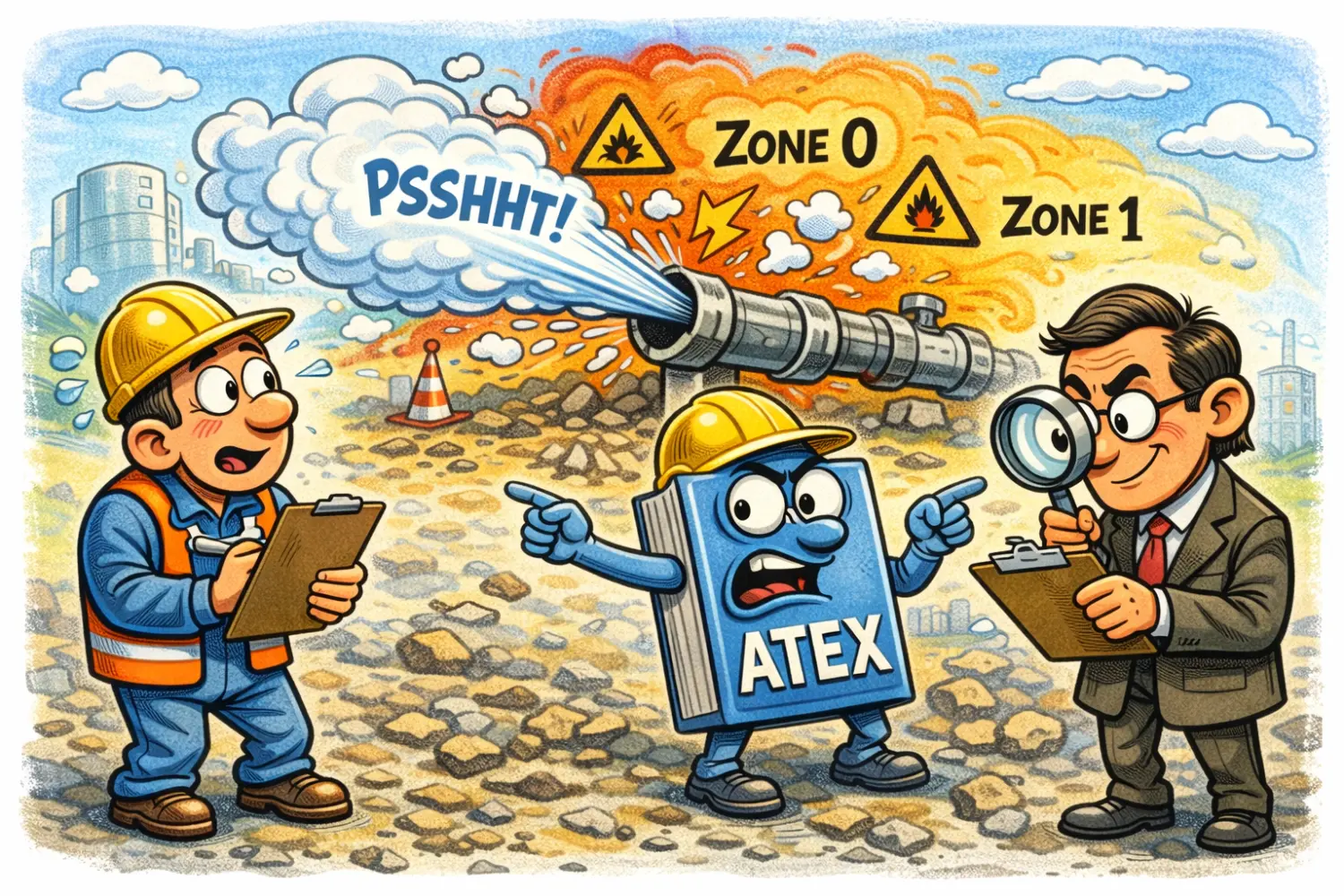
The correct approach is 1. Manufacturer ensures containment and machine safety 2. Operator evaluates leak scenarios and hazardous zones 3. Equipment in zones is ATEX certified (with Notified Body involvement).
Keep up the good work!
Note: Your comment will only appear on the site after review. Your email address will not be visible, only your name and comment.