

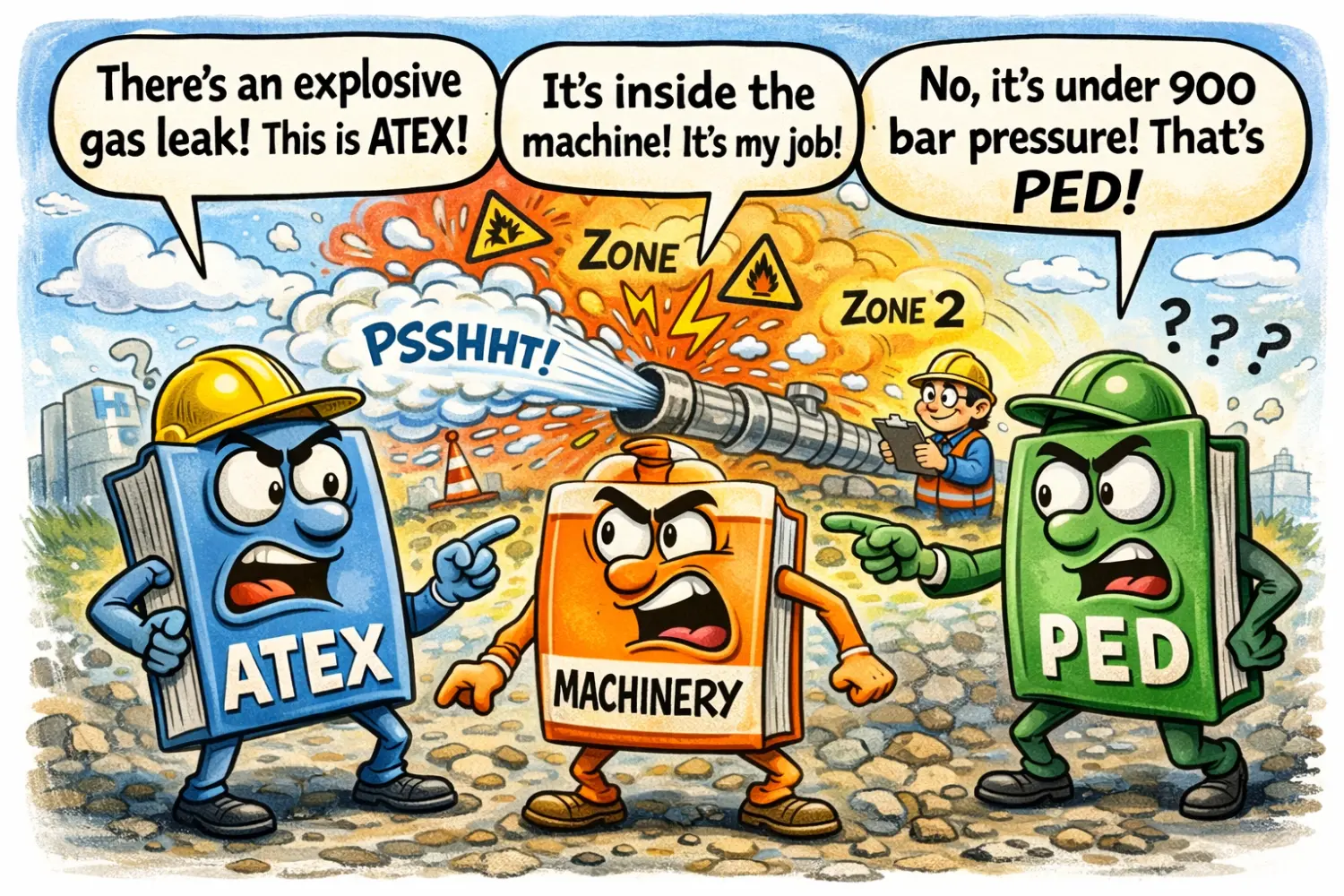
My aim here is to understand the boundary between internal process safety and external explosion risk.
How the Responsibilities Split
|
Area |
Regulation |
Responsible |
|
Hydrogen vessel, piping |
PED |
Manufacturer |
|
Compressor, electrolyzer |
Machinery Regulation |
Manufacturer |
|
Leak prevention |
Machinery + PED |
Manufacturer |
|
Hazardous area around system |
ATEX Workplace |
Operator |
|
Equipment installed in zone |
ATEX Equipment Directive |
Manufacturer + Notified Body |
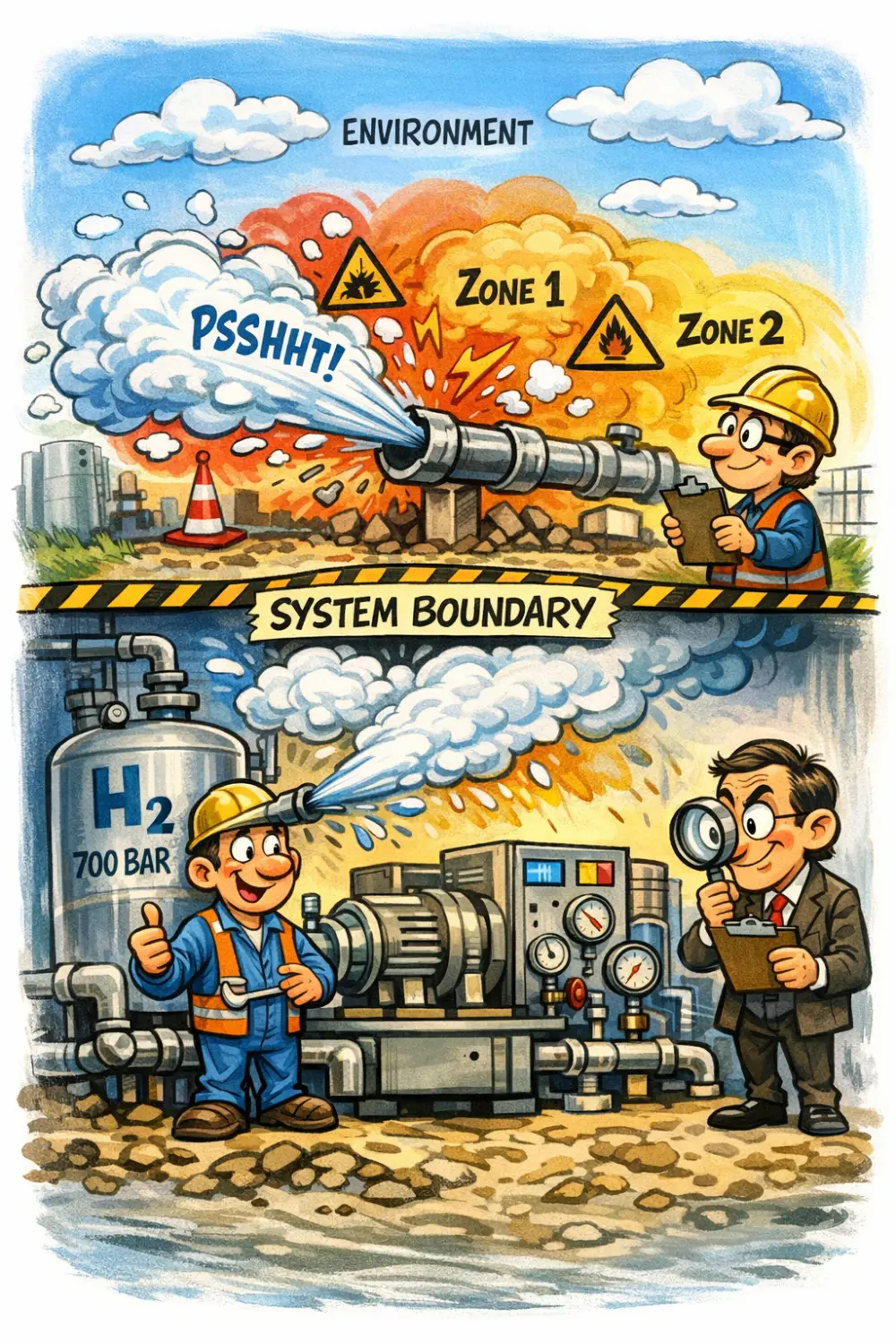
Important Engineering Insight: The regulatory boundary is not the machine housing. The real boundary is: the point where hydrogen can mix with air. Inside:
Outside:
So ATEX becomes relevant immediately.
Safety Philosophy Used in Hydrogen Systems
Hydrogen installations normally follow this hierarchy: 1) Prevent leaks (design integrity) 2) Detect leaks (H2 sensors) 3) Dilute hydrogen (ventilation) 4) Shutdown system (ESD) 5) ATEX protection if needed
Goal Is to avoid hazardous area classification entirely. Many modern hydrogen installations aim for: No Zone → ventilated outdoor installation
Real Example: Hydrogen Refueling Station
|
Component |
Regulation |
|
Storage cylinders (900 bar) |
PED |
|
Compressor skid |
Machinery |
|
Control system |
Machinery |
|
Vent stack area |
ATEX zone classification |
|
Electrical, non electrical equipment near vent |
ATEX certified |
In hydrogen safety courses the rule is usually summarized as Inside the system → Machinery + PED // Outside the system → ATEX
Keep up the good work!
Note: Your comment will only appear on the site after review. Your email address will not be visible, only your name and comment.