
Streets were ripped open. Buildings collapsed. Vehicles were thrown into the air. Underground infrastructure was destroyed over kilometres.
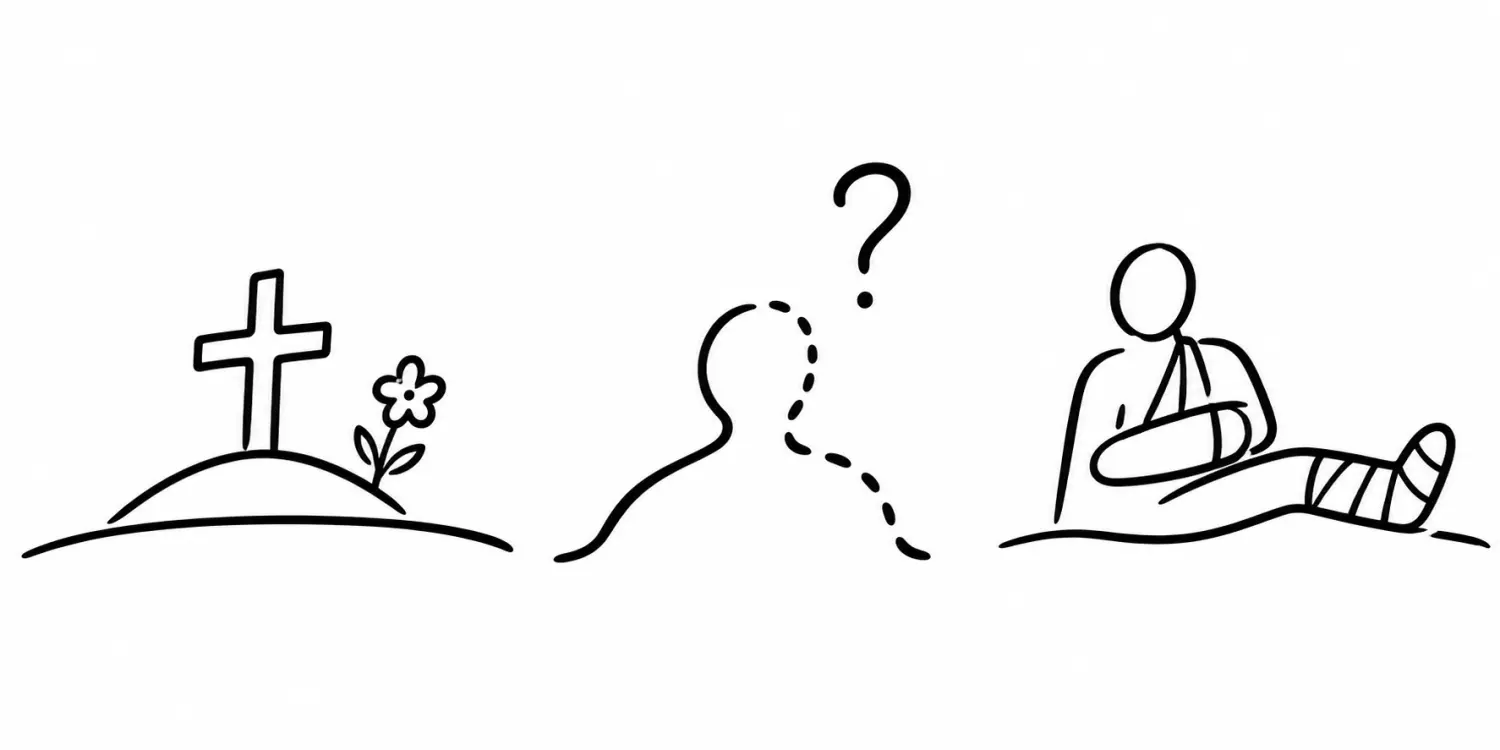
Mexico's National Center for Disaster Prevention, CENAPRED, records 212 deaths, 69 people missing and 1,800 injured, with more than eight kilometres of streets destroyed or severely affected. It also records damage to 1,142 homes, 450 businesses, 100 schools and 600 vehicles. Other contemporary and later sources give somewhat different casualty figures, which is why the precise toll should be treated with care.
But the most important part of the Guadalajara story is not simply the scale of the explosion.
There were warnings before it happened.
The days before the explosions
Residents in the affected area had reported a strong smell of gasoline coming from the sewer system in the days preceding the disaster. CENAPRED also records reports of small columns of vapour or smoke emerging from some locations.
Contemporary reporting confirms that residents had complained about gasoline odours before the explosions and subsequently strongly criticised the authorities' response.
Authorities investigated the sewer network:
According to contemporary reporting by the Los Angeles Times, fire and water-department personnel had been monitoring gas concentrations, but monitoring stopped during the early hours of 22 April because personnel considered the threat insufficient to justify evacuation. Jalisco's governor later stated that fumes had consequently been allowed to accumulate unmonitored for several hours.
The population was not evacuated. This is one of the most important facts in the entire case. There was evidence of hydrocarbons where hydrocarbons should not have been. There were complaints from the public. There was monitoring. And there was enough concern for authorities to investigate. Yet the situation did not result in the removal of the exposed population before the explosions.
22 April 1992
At approximately 10:00 in the morning, the situation became catastrophic.
The University of Guadalajara records the beginning of the explosions at approximately 10:05, in the city's Colector Intermedio de Oriente sewer system.
Contemporary Associated Press reporting described at least nine explosions, enormous craters, overturned trucks and buses, collapsed houses and streets torn apart. Initial casualty figures changed rapidly as rescue operations continued.
The explosions propagated through sections of the underground sewer network.
The French government's ARIA industrial-accident database describes ignition of gases accumulated inside sewer collectors following a leak from a hydrocarbon pipeline. Some of the collectors were approximately 3.5 metres in diameter and buried around eight metres below street level.
The result above ground was devastating.
Where did the fuel come from?
There was considerable confusion immediately after the disaster. Early reports suggested that hexane, potentially originating from a vegetable-oil facility, might have entered the sewer. Pemex initially pointed toward this explanation. That conclusion did not survive the subsequent investigation.
On 26 April, Mexico's Attorney General announced that gasoline leaking from an underground pipeline operated by the state oil company Pemex was the principal source of the disaster. The finding contradicted Pemex's earlier position that damage to its pipeline had resulted from the explosions rather than caused them.
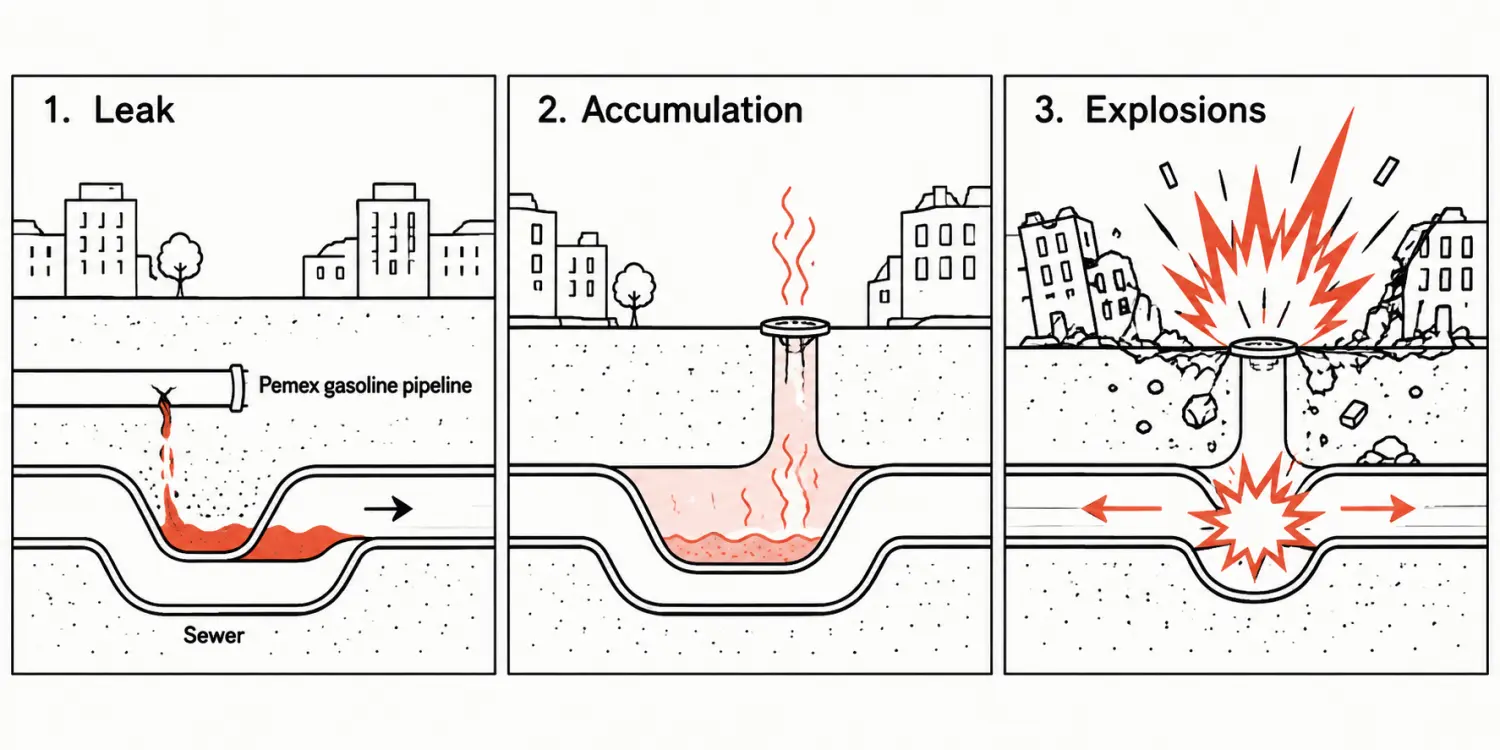
CENAPRED today states that gasoline escaped from the Salamanca–Guadalajara pipeline, entered the wastewater collector and produced flammable vapours within the sewer system.
The French ARIA accident database similarly identifies a hydrocarbon pipeline leak and refers to corrosion of the pipeline, potentially involving galvanic corrosion associated with neighbouring underground utility lines.
This is an important engineering aspect of the accident: underground infrastructure cannot always be considered as a collection of independent systems.
A fuel pipeline, water infrastructure, sewer system and transport infrastructure may belong to different organisations and serve completely different purposes.
Physically, however, they occupy the same environment. A change to one can alter the risk of another.
The sewer became a containment system
A second factor made the situation particularly dangerous.
Construction associated with Guadalajara's transport infrastructure had required a siphon beneath Calzada Independencia.
CENAPRED explains that this arrangement created a hydraulic seal that prevented the accumulated flammable vapours from dispersing adequately. Gasoline reaching the wastewater collector generated vapours, which accumulated until an ignition source initiated the explosions.
The University of Guadalajara gives a similar account, while importantly noting that aspects of the official explanation were not conclusively proven. It describes gasoline and other hydrocarbons entering the sewer, vapour generation in warm conditions, and accumulation associated with the hydraulic seal created by the siphon.
This distinction matters. It is reasonable to state as established that flammable hydrocarbons accumulated within the sewer system and were ignited.
It is less appropriate to present every detail sometimes repeated in popular accounts - such as an exact sequence of sparks and pressure waves igniting each subsequent sewer section - as conclusively established fact.
The precise ignition source remains much less important than the fundamental hazardous condition: a large confined underground volume had acquired a flammable atmosphere. Once that condition existed, only an effective ignition source was required.
This was not simply a pipeline failure
Looking at Guadalajara only as a leaking-pipeline accident misses an important part of the lesson. The event involved several layers:
Loss of containment: gasoline escaped from hydrocarbon infrastructure.
Migration: the released product reached another underground system.
Accumulation: the sewer geometry and ventilation conditions allowed flammable vapours to accumulate.
Ignition: an ignition source encountered the explosive atmosphere.
Escalation: the interconnected sewer system allowed the consequences to extend over a large urban area.
But there was another layer: warning and decision-making.
People had reported gasoline odours. Authorities knew abnormal hydrocarbons were present. Investigations and monitoring had begun. Yet thousands of people remained above an underground system containing an uncontrolled flammable atmosphere.
Following the disaster, Guadalajara mayor Enrique Dau Flores stepped aside while the investigation proceeded. Contemporary reports show that officials from the municipality and Pemex came under investigation, and the Attorney General's findings attributed significant responsibility to failures associated with the pipeline and the response to the developing emergency.
The later legal history was more complicated than the initial public attribution of responsibility, and therefore it would be misleading to reduce the case to a simple statement that one individual or organisation was legally responsible for everything that occurred.
The Ex lesson
Although Guadalajara was not an industrial hazardous-area installation in the conventional ATEX or IECEx sense, the accident illustrates a fundamental principle of explosion protection:
A hazardous area can appear where nobody intended one to exist.
A sewer is not normally designed as a process vessel. But introduce a flammable liquid. Allow it to evaporate. Limit ventilation. Provide sufficient confinement. Bring the concentration between the lower and upper flammable limits. Then introduce an effective ignition source.
The physical requirements for an explosion do not care whether the location was originally classified as a hazardous area.
For today's Head of Operations, plant manager or Ex professional, Guadalajara raises a particularly useful question:
What happens in your organisation when flammable material is detected somewhere it should never be?
Does somebody merely take a measurement? Or does that measurement trigger a predefined decision?
Because detecting a hazardous atmosphere is not the same thing as controlling it. Monitoring without clearly defined actions, authority, escalation criteria and evacuation or shutdown thresholds can create the appearance of control while the underlying hazardous condition continues to develop.
The deeper lesson: abnormal conditions require decisions
The Guadalajara disaster is often presented as a story about corrosion, pipelines or badly designed sewers.
All of those issues matter.
But from an Operational Ex perspective, its strongest lesson comes earlier in the sequence.
Something abnormal was detected before the catastrophe.
That should trigger questions immediately:
Where is the flammable substance coming from? Where can it migrate? Where can it accumulate? Can the atmosphere reach the flammable range? What ignition sources exist? How far can the hazardous atmosphere extend? What must be isolated? Who has authority to stop operations or evacuate? And what evidence would justify declaring the situation safe again?
Those questions remain relevant far beyond Guadalajara.
The same logic applies when solvent appears unexpectedly in a drain, hydrogen is detected outside its expected containment, fuel enters a cable trench, LPG migrates through underground ducts, or combustible dust accumulates inside equipment that was never intended to contain it.
The first indication may look like a maintenance problem. It may actually be the beginning of an explosion scenario. Guadalajara demonstrated the difference in the most tragic possible way.
The warning sign is not the barrier. The measurement is not the barrier. The report is not the barrier.
The barrier is the effective action that follows them.
Sources
CENAPRED – Centro Nacional de Prevención de Desastres, Government of Mexico: Efeméride: A 28 años de las explosiones en Guadalajara (22 April 2020). Official Mexican disaster-prevention summary of the accident, casualties, gasoline release and sewer accumulation.
CENAPRED – Government of Mexico: A 34 años de las explosiones en Guadalajara (22 April 2026). Current official retrospective confirming reports of gasoline odour before the event and identifying the Salamanca–Guadalajara pipeline spill.
Universidad de Guadalajara: 22 de abril de 1992 – Explosiones en Guadalajara. Useful because it records the official casualty figures while also acknowledging uncertainty surrounding parts of the official causal explanation.
ARIA / French Ministry responsible for the environment – Accident No. 3543: Series of explosions in the city sewers. Technical accident record describing hydrocarbon leakage, accumulation in large sewer collectors, corrosion and consequences.
The Washington Post / Associated Press: Explosions Kill 184 in Guadalajara, 22 April 1992. Contemporary reporting from the day of the disaster; particularly useful for understanding what was known — and what was still incorrectly believed — immediately after the explosions.
The Washington Post: Pemex Faulted in Mexican Blasts, 27 April 1992. Contemporary reporting on the findings of the Mexican Attorney General's investigation identifying gasoline leakage from the Pemex pipeline as the principal source.
Los Angeles Times: Guadalajara Officials Quit Over Explosion, 25 April 1992. Contemporary reporting concerning monitoring before the explosions, the decision not to evacuate and the subsequent investigation.
El País: Contemporary reporting of 26–27 April 1992 on the official investigation and proceedings involving municipal and Pemex officials.
Note: Your comment will only appear on the site after review. Your email address will not be visible, only your name and comment.