

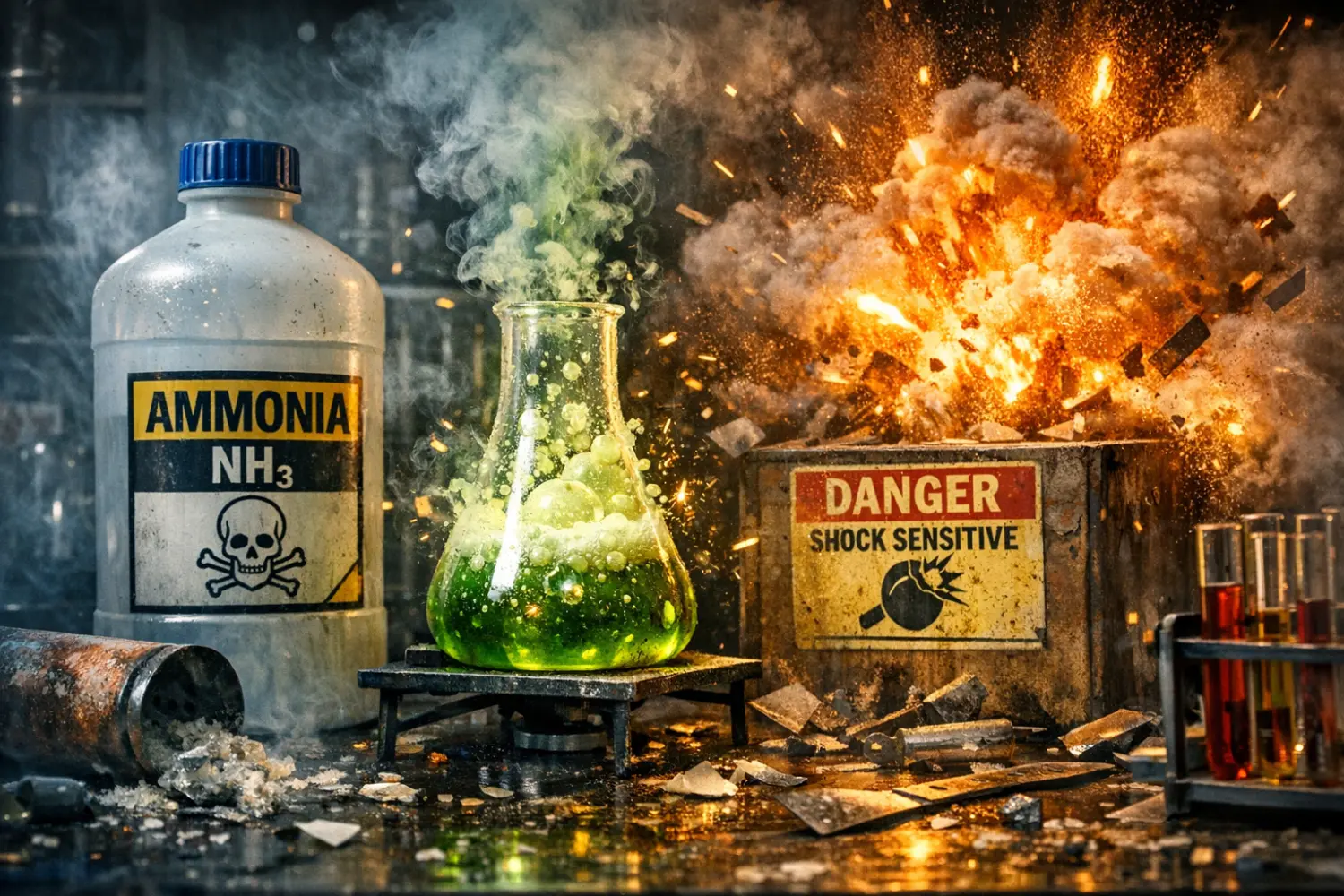
Why ammonia becomes dangerous in mixtures?
Ammonia (NH₃) is a reducing agent, a nitrogen donor and chemically reactive with oxidizers and certain metals. When mixed with the wrong substances, it can form Highly unstable intermediates, Shock-sensitive compounds and Violent exothermic reactions.
Halogens (F₂, Cl₂, Br₂, I₂)
Halogens are strong oxidizers; ammonia is a reducing agent → redox reaction.
Typical outcome is formation of nitrogen trihalides, e.g.: Nitrogen trichloride (NCl₃), Nitrogen tribromide (NBr₃) and Nitrogen triiodide (NI₃). This is dangerous because these compounds are Extremely unstable, Shock-sensitive and Can detonate from Touch, Heat and Drying
Classic example: nitrogen triiodide (NI₃), which Can explode just by a slight vibration
Industrial relevance
Mixing ammonia + chlorine = real accident scenario
Hypochlorite (bleach)
Reaction pathway is Ammonia + hypochlorite (NaOCl) → Chloramines + possibly NCl₃
Products are NH₂Cl (monochloramine), NHCl₂ (dichloramine) and NCl₃ (nitrogen trichloride). Possible hazards are Toxic gas release (primary risk) and Explosion risk (secondary but real).
NCl₃ is Volatile and Explosive under certain conditions
In industrial scale missing is possible E.g: cleaning systems, CIP systems and Water disinfection → this can become a major process safety hazard
Ethylene oxide (C₂H₄O)
Reaction is Ethylene oxide + ammonia → ethanolamines
Where the danger here might come from: it is Highly exothermic and the Ethylene oxide is Flammable and Explosive by itself
Risk scenarios are Runaway reaction, Overpressure and Loss of temperature control.
Metals: gold, silver, mercury
Formation of explosive compounds so Ammonia can react with metal ions to form Ammine complexes and Some of which become explosive precipitates. Examples:
Silver: "Fulminating silver" (Ag compounds with ammonia) → Highly sensitive explosive
Mercury → Similar unstable compounds
Gold → Forms unstable ammine complexes under certain conditions
Key risk it Often forms during cleaning or analytical processes, which can accumulate unnoticed and Becomes dangerous when Dried and Disturbed
|
Interaction type |
Main hazard |
|
Halogens |
Explosive compounds |
|
Hypochlorite |
Toxic + explosive |
|
Ethylene oxide |
Runaway / explosion |
|
Metals (Ag, Hg, Au) |
Shock-sensitive solids |
This is more like a Chemical incompatibility hazard, which means even outside flammable limits and even without air YOU can still get Explosion, Detonation and Violent decomposition.
Keep up the good work!
Note: Your comment will only appear on the site after review. Your email address will not be visible, only your name and comment.